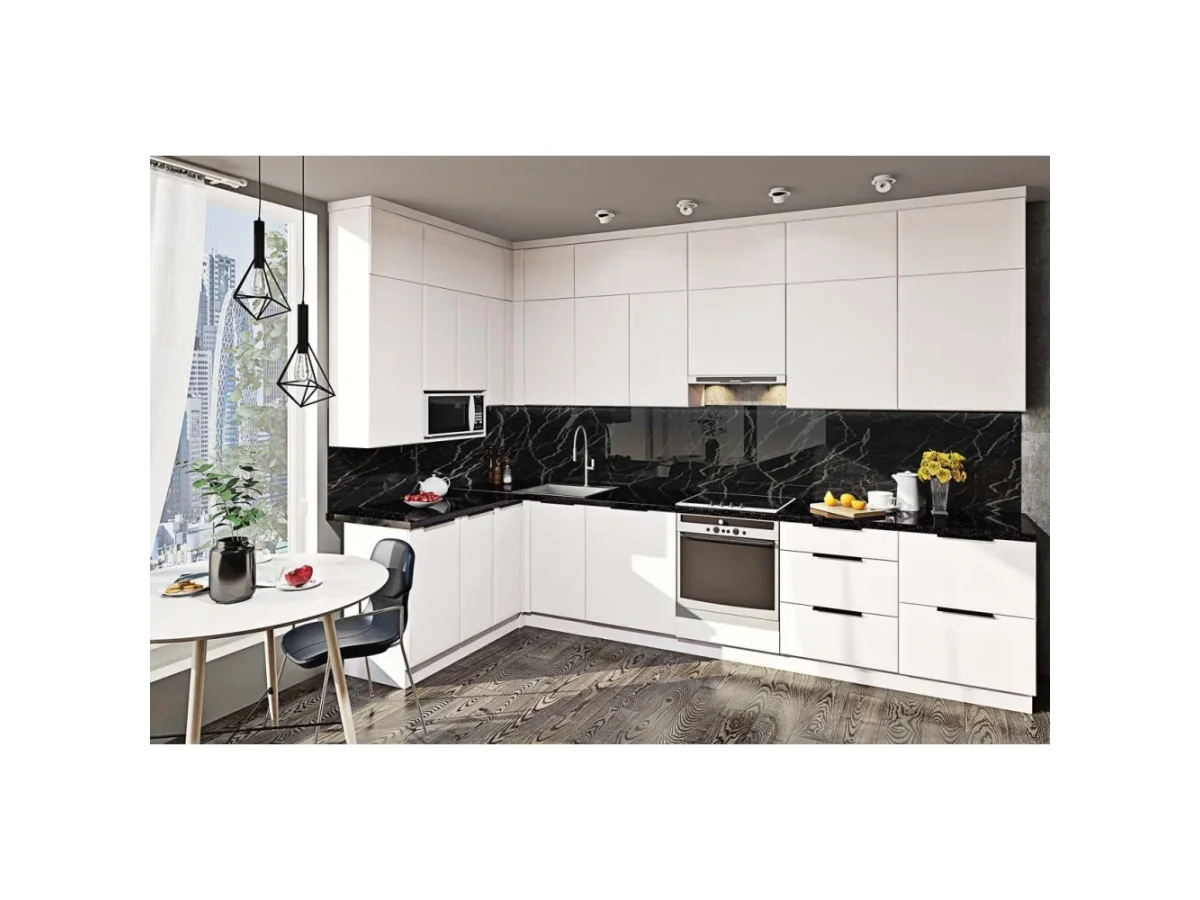
Built-in kitchens for individual projects
In any city, one can count hundreds of different layouts of multi-story buildings built at different times, not to mention countless private homes, each one distinct from the next. Differences in room sizes of just a few centimeters can occur in buildings constructed according to identical designs, and even within a single building, as builders often neglect to maintain the strict shapes stipulated in the plans, even for external load-bearing walls, let alone internal partitions. For these reasons, finding two rooms that are exactly the same in geometric shape and size is unlikely. Therefore, even with an overwhelming desire to satisfy everyone in advance, furniture manufacturers simply would not be able to do so due to fundamental limitations on the feasibility of such a task. Consequently, no matter what single-piece piece is purchased, it will not be able to fully adapt to the specific needs of a particular space, and even modular kits can only alleviate any problems that arise, but not completely eliminate them. And only then built-in kitchens They are able to take into account every single nuance and leave the owners of the living space with absolutely no dissatisfaction after the installation is completed.
What problems do built-in kitchens solve and how do they solve them?
Modern built-in kitchens effectively solve several problems that are relevant to almost every homeowner. Here are the most important:
As noted above, combining two completely finished products—an existing room and a manufactured piece of furniture—is practically impossible. In such cases, the most sensible approach is to adapt the unchangeable first piece to the second piece during the design process, taking into account the order in which they were created. This requires careful measurements of all room dimensions, including walls, floors, ceilings, door and window openings, and the locations of utility lines. The shape and configuration of the relative placement of all furniture components is then planned accordingly. This approach eliminates any gaps or crevices, eliminating any obstacles that might hinder user movement. The available floor space is utilized most efficiently, eliminating dust accumulation and nuisance habitats for spiders, cockroaches, and other insects.
When placing an order, the future operator can always specify their preferences regarding the placement of all necessary functional units, such as a sink, refrigerator, gas oven, and work surfaces for food preparation and consumption. The same applies to the storage of ingredients, kitchen utensils, and any equipment and devices used for food processing.
Thanks to the consistent stylistic design of all the elements that make up the façade, which often conceal not only the unsightly range hood but also the out-of-place stove and freezer, a completely harmonious picture is created. The absence of dissonant areas ensures a calm aesthetic perception of the entire created scene, which in turn reduces irritation and helps the homeowner focus on the painstaking daily chores.
There are many others collected under the general title kitchens varieties of furnishing items for rooms of the same name, some of which are worth mentioning separately.
Modular kitchens
Similar results in terms of useful filling of the available space can be achieved modular kitchens However, they don't completely solve all the problems, as it's impossible to take into account the individual dimensions of each room during their development. Furthermore, each individual unit must be carefully finished on all potentially visible sides, which increases material consumption and, consequently, leads to a slight increase in the cost of the ready-to-install kit. Unlike built-in units, they can be used elsewhere after moving to a different apartment or house, which is undoubtedly a significant advantage.
Corner kitchens
Another variation that allows one to partially get rid of the difficulties outlined at the very beginning is corner kitchens They are clearly capable of tightly blocking a space in one corner of the room, but they don't solve the problem with the rest, and it becomes better to redesign utility lines to accommodate them, rather than the other way around.
Write a comment